The Linked Web Storage Protocol specification aims to provide applications with secure and permissioned access to externally stored data in an interoperable way.
The Linked Web Storage Protocol does/does not include protocol details for integration with identity layers and mechanisms; access management and data integrity; notifications about resource changes; and authorization mechanisms.
This is an unofficial proposal.
For Editors
List of TODOs and ideas in flux to enable editors to communicate asynchronously.
+ Previous editors: Added formal past editors section recognizing Justin Bingham, Dmitri Zagidulin, Sarven Capadisli, Tim Berners-Lee and Ruben Verborgh
+ HTTP Server MUST generate a Last-Modified header field in response to GET and HEAD requests.
- The PATCH ?insertions formulae MUST NOT contain blank nodes.
+ IANA Reg Security Considerations: Servers are strongly encouraged to implement additional security measures…
+ IANA Reg Privacy Considerations: Servers are encouraged to respond with the 451 status code…
Tactics
Reference UCS Glossary for now to keep them in sync.
Include REST examples but keep spec abstract to:
provide intuitive names for states, operations, and responses
factor states, operations and responses so e.g. update resource responses are the same from HTTP PATCH or from HTTP PUT
enable alternate bindings.
I like to have a marker (e.g. left-border) to highlight informative regions, but it's pretty ugly.
Document Conventions
Introduction
This specification defines the Linked Web Storage (LWS) Protocol, which enables client applications to access and manage web resources, based on the identity and permissions of an agent.
By standardizing how a resource server manages and provides access to a hierarchy of linked resources, the protocol enables users to use different client applications to interact with the same stored data. These linked resources are defined through containers and containment relationships that describe where things are located, and metadata that describes how the resources relate to each other.
The protocol defines standard operations on these resources to create, read, update, and delete. Each resource is identified by a URI. A client navigates the resource hierarchy from a root container, discovering contained resources and their relations through links provided in server responses.
An agent's identity is confirmed through an identity provider that can be external to the Linked Web Storage server. This loose coupling means the server does not necessarily manage credentials directly; rather, it can receive and validate a signed authentication credential as a token issued by a trusted identity provider. A user can therefore present an existing identity to a compliant server, without always needing a new or existing account just for that server. LWS makes use of user authentication as defined in specifications for OpenID Connect, SAML 2.0, and self-signed controlled identifiers (CIDs), for example.
Authorization determines whether a requesting agent has permission to access a resource or perform an operation on it. A compliant LWS server designates a resource manager for each resource that determines whether a resource is private (i.e., available only to its owner), restricted (i.e., available to a defined set of users), or public (i.e., available to any user). The server enforces the access decisions of the resource manager when handling each client request.
This specification is intended to be used by:
Developers building client applications that access Storage Resources
Developers building compliant servers that mediate access to Storage Resources
Different LWS server instances each maintain their own hierarchy of linked resources. An agent might use the same identification to navigate across servers, with access to each server's resources determined by the permissions granted by that server's resource managers. It is not guaranteed that every LWS server instance will support every possible agent identifier; any given LWS server instance might require that an agent identify itself via a particular identity provider, to gain access to resources managed by that server instance.
Resource Access
The LWS Protocol defines standard interactions by which some party can make some resources available to some agents.
served resource - (available resource? published resource?) (not defined in UCS) A network-accessible entity exposed by a service for interaction, retrieval, or manipulation using the protocol defined in this document.
requesting agent - (entity in UCS) An entity (e.g., client, user, or process) that initiates a request to interact with a servable resource.
A LWS Server is an HTTP server [[!rfc9112]] that complies with all of the relevant "MUST" statements in this specification. Specifically, the relevant normative "MUST" statements in of this document MUST be respected.
An LWS Client is an HTTP client [[!rfc9112]] that complies with all of the relevant "MUST" statements in this specification. Specifically, the relevant normative "MUST" statements in of this document MUST be respected.
Scope Diagrams
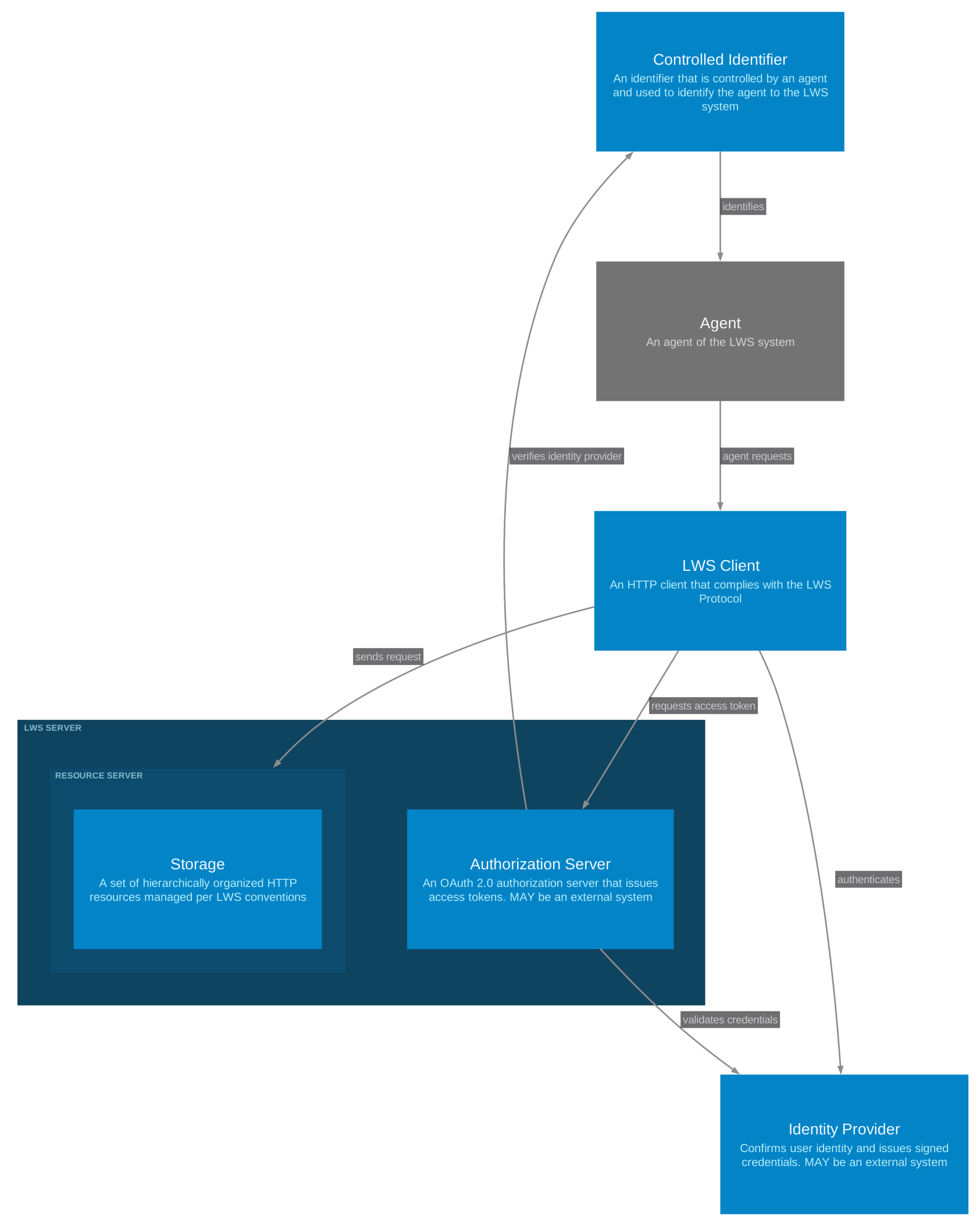
The following diagrams are platform-independent models
to guide implementation.
System Context shows the LWS System and its major components.
Terminology
The terms "authorization server" and "client" are defined by the OAuth 2.0 Authorization Framework [[!RFC6749]].
The terms "end-user" and "issuer" are defined by OpenID Connect Core 1.0 [[!OPENID-CONNECT-CORE]].
This specification defines the following terms:
access grant — a data object created by a storage controller, expressing
an ability for an agent to perform specific actions on Storage Resources within certain
defined constraints.
access profile — an access profile describes the
requirements for expressing a valid access policy. Every access profile is identified
with a URI, and a server indicates support for one or more access profiles by
referencing them in the conformsTo property of a service object in its
storage description resource.
access request — a data object submitted by an agent, expressing a
request to perform specific actions on Storage Resources, including the desired scope
and constraints.
agent — a person, social entity, or software identified by a URI.
authentication credential — a security token that asserts claims about an agent or end-user. This token is secured with a cryptographic proof.
Examples of authentication credentials include assertions of identity such as OpenID Connect ID Tokens and SAML-based assertions as well as assertions of
capability such as ZCAPs.
authentication suite — a defined validation mechanism for a concrete serialization of an authentication credential.
auxiliary resource — a Storage Resource that plays a particular role with respect to a Storage Resource, called its primary resource,
and whose lifetime is bound to the primary resource.
This specification defines linkset resource and metadata resource as types of auxiliary resources,
but LWS Servers are free to manage additional kinds of auxiliary resources (e.g. access control resources, notification inboxes).
Auxiliary resources are discovered using web links [[RFC8288]] of a specific type (see Section ).
Some auxiliary resources may, in some implementations, be identical to their primary resource.
Storage Resource — an HTTP resource as defined in [[[RFC9110]]] which supports the read operations defined by the Linked Web Storage Protocol.
Following [[[RFC9110]]], this specification "does not limit the nature of a resource; it merely defines an interface that might be used to interact with resources." [[RFC9110]]
This class is identified by the IRI https://www.w3.org/ns/lws#StorageResource.
container — a Storage Resource that is able to enumerate a collection of Storage Resources, conforming to the conventions described in Section 8. Containers. The ability to create new resources in a container or to delete an existing container follows the requirements outlined in Section 9. Operations.
data resource — a data-bearing Storage Resource such as a document, image, or structured information whose support for update and delete operations follows the requirements outlined in Section 9. Operations.
linkset resource — a type of auxiliary resource whose representation conforms to [[[RFC9264]]]. Update operations for linkset resources follow the requirements outlined in Section 9. Operations.
resource — a resource is, as described by [[WebArch]] and [[RFC3986]], "whatever might be identified by a URI". Resources whose essential characteristics can be conveyed in a message (such as web pages, images, structured data objects...) are called information resources [[WebArch]].
storage — a set of hierarchically organized HTTP resources whose lifecycle is managed by the conventions described by the Linked Web Storage Protocol. A storage is described by a storage description resource which references a collection of services that provide affordances over those resources.
storage controller — an agent that controls all resources in a storage.
storage description — a Storage Resource, conforming to the requirements of a W3C Controlled Identifier document [[!CID-1.0]], that describes a storage along with its services and capabilities.
notification — a message describing an event that has occurred on a resource.
subscription — a registration expressing interest in receiving notifications for a given resource or set of resources.
subscriber — the agent that creates a subscription and receives the resulting notifications.
notification suite — a defined delivery mechanism for a concrete channel through which notifications are sent to a subscriber.
This specification defines operations on served resources, the resulting change of state, and a response intended to give the requesting agent requested information or inform them of the outcome of the operation.
An operation is any of the following actions that can be performed on a served resource:
create resource -
read resource -
update resource -
delete resource -
The following section will describe the semantics and responses of these operations but the following core responses apply to any operation:
success - the operation is believed to have completed. This may be accompanied by a resource representation conveying the contents of a served resource. A success response is not defined for the create resource operation. See instead created.
not permitted
unknown requester
unknown error - reserved for error conditions that arise that are not anticipated by the specification
Authentication
Authorization
Discovery
Logical Resource Organization
Containers
Operations
Create resource
Read resource
Update resource
Delete resource
Notifications
Access Requests and Grants
LWS Media Type
JSON-LD Context
Resource Identification
Define how resources are identified and addressed within the LWS Protocol, including URI schemes, resource naming conventions, and resolution mechanisms. This section may be moved within another section; e.g. Resource Access
Portability Considerations
Describe considerations for ensuring LWS implementations can work across different platforms, environments, and storage backends while maintaining interoperability - and provide affordances to enable change in storage providers
Security Considerations
Formal security considerations section covering threat models, security requirements, and implementation guidance for secure LWS deployments.
Privacy Considerations
Privacy implications of the LWS Protocol, including data minimization, user consent, and privacy-preserving implementation patterns.
IANA Considerations
Acknowledgements
This specification draws heavily from the Solid Protocol [[Solid-Protocol]], which was edited, over time, by
Sarven Capadisli, Tim Berners-Lee, Kjetil Kjernsmo, Ruben Verborgh, Justin Bingham, Dmitri Zagidulin.