ODRL AI Vocabulary Profile
As can be clearly seen by these existing approaches in Section 3, they vary in consistency in their model and semantics, and hence will dilute data interoperability for AI governance across the Web and Enterprise.
Using the current set of AI vocabularies described in Section 3 as a snapshot of the AI community requirements, the ODRL AI Vocabulary Profile takes a more bigger-picture view by providing an extensible Data Processing framework that captures current state needs, as well as sets the platform for future growth. The figure below shows the framework and current scope of the AI vocabulary, including their hierarchy in the framework.
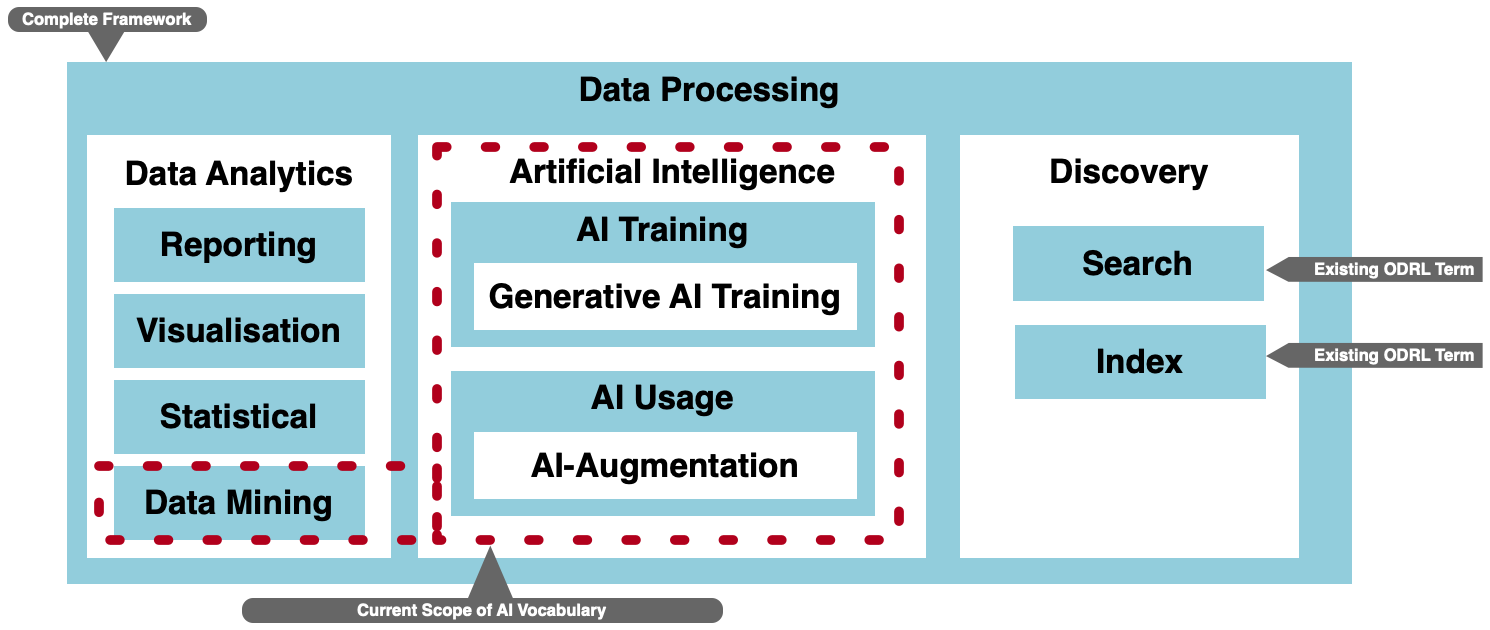
The current scope of the AI Vocabulary consists of six new terms and includes two existing ODRL Vocabualry terms. The new terms also represent a hierarchy, enabling ODRL policies to more simply include the inherited terms. The terms are summarised here:
- Artificial Intelligence - the asset is used in Artificial Intelligence computational systems
- AI Training - the asset is used to train/modify an AI model
- Generative AI Training - the asset is used to train/modify a Generative AI model
- AI Usage - the asset is used to perform tasks with AI systems
- AI Augmentation - the asset is used as input to a trained AI model
- Data Mining - the asset is used for algorithmic analysis
- Index - the asset is registered in a data store
- Search - the asset is discoverable in a data store
NOTE: Data Mining is not considered as the parent term in this framework, as that is not the industry consensus.
The next sections formally defines these vocabulary terms.
Artificial Intelligence (AI)
| Definition: | The act of using asset(s) with computational systems capable of performing artificial intelligence tasks |
|---|---|
| Label: | Artificial Intelligence (AI) |
| Identifier: | http://www.w3.org/ns/odrl/2/ai |
| Note: | Artificial Intelligence encompasses a broad range of techniques and systems, including machine learning, deep learning, and generative AI systems. |
| Included In: | Use |
| Class: | Action |
| Mapping: |
This vocabulary term has similar semantics to:
|
AI Training
| Definition: | The act of using asset(s) to modify the parameters, internal representations, or learned behaviour of an artificial intelligence model or system to enable or improve its performance |
|---|---|
| Label: | AI Training |
| Identifier: | http://www.w3.org/ns/odrl/2/ai-training |
| Note: | AI Training includes initial model training, continued pre-training, fine-tuning, and other training processes that modify a model based on data |
| Included In: | Artificial Intelligence (AI) |
| Class: | Action |
| Mapping: |
This vocabulary term has similar semantics to:
|
Generative AI Training
| Definition: | The act of using asset(s) to train or modify a generative artificial intelligence model so that it can generate new content, including text, images, audio, video, software code, or other forms of output |
|---|---|
| Label: | Generative AI Training |
| Identifier: | http://www.w3.org/ns/odrl/2/ai-train-gen |
| Note: | Generative AI Training includes initial training, continued pre-training, fine-tuning, and other training processes that modify a generative AI model |
| Included In: | AI Training |
| Class: | Action |
| Mapping: |
This vocabulary term has similar semantics to:
|
AI Usage
| Definition: | The act of using asset(s) to an artificial intelligence system to perform a task or obtain an output, without necessarily modifying the system’s learned model parameters |
|---|---|
| Label: | AI Usage |
| Identifier: | http://www.w3.org/ns/odrl/2/ai-usage |
| Note: | AI Usage includes activities such as prediction, classification, summarisation, question answering, content generation, and decision support by providing information to an AI system |
| Included In: | Artificial Intelligence (AI) |
| Class: | Action |
| Mapping: |
This vocabulary term has similar semantics to:
|
AI Augmentation
| Definition: | The act of using asset(s) as input to pre-trained AI models to assist, enhance, or extend their capabilities in performing a task, while retaining involvement in evaluating, directing, or acting upon the resulting output |
|---|---|
| Label: | ai-augment |
| Identifier: | http://www.w3.org/ns/odrl/2/ai-augment |
| Note: | AI Augmentation includes activities in which AI supports human or computational capabilities, such as assisting with research, improving decision-making, generating recommendations, supporting software development, or enhancing creative work. NOTE: This term is sometimes referred to as inference. |
| Included In: | AI Usage |
| Class: | Action |
| Mapping: |
This vocabulary term has similar semantics to:
|
Data Mining
| Definition: | The act of using asset(s) in analysing or computationally processing data to identify, extract, or derive patterns, relationships, trends, correlations, structures, or other information that may not be explicitly represented in the original data |
|---|---|
| Label: | data-mining |
| Identifier: | http://www.w3.org/ns/odrl/2/data-mining |
| Note: | Data Mining may involve statistical analysis, pattern recognition, clustering, association analysis, or other computational techniques |
| Included In: | Use |
| Class: | Action |
| Mapping: |
This vocabulary term has similar semantics to:
|
Search
| Definition: | The act of enabling the asset(s) to be discoverable in a data store |
|---|---|
| Label: | Search |
| Identifier: | http://www.w3.org/ns/odrl/2/search |
| Note: | |
| Included In: | Use |
| Class: | Action |
| Mapping: |
This vocabulary term has similar semantics to:
|
Index
| Definition: | The act of enabling the asset(s) to be recorded in the index of a data store |
|---|---|
| Label: | Index |
| Identifier: | http://www.w3.org/ns/odrl/2/index |
| Note: | For example, to include a link to the Asset in a search engine database after the Asset has been processed by an algorithm. This term is the same as defined in the ODRL Common Vocabulary. |
| Included In: | Use |
| Class: | Action |
| Mapping: |
This vocabulary term has similar semantics to:
|