Introduction
This document provides a threat model for the Verifiable Credential Barcodes specification, which supports two use cases:
- Encoding generic verifiable credentials as barcodes. Any appropriate verifiable credential can be compressed with CBOR-LD, character-encoded, and printed as a barcode. In this use case, the credential's Data Integrity proof covers exactly the claims included in the credential itself.
-
Securing existing optical data with
OpticalBarcodeCredential. Verifiable Credentials of typeOpticalBarcodeCredentialcan use theecdsa-xi-2023Data Integrity cryptosuite to protect via digital signature not only the claims in the credential itself, but also other machine-readable data already printed on a physical document - such as the PDF417 on a driver's license or a machine-readable zone.
In both cases, a credential that successfully verifies is guaranteed to have
originated from the claimed issuing authority (authenticity) and to carry data
unmodified since issuance (integrity), and the document's revocation or
suspension status can be checked in real time - all without a privacy-invasive
"phone home" to a source-of-truth database. The two use cases differ in what
the digital signature covers: a generic credential's signature covers only the
credential's own claims, while an OpticalBarcodeCredential's
signature also covers selected optical data on the document.
This threat model follows the methodology described in the W3C Threat Modeling Guide and uses the STRIDE taxonomy for classifying threats. Threats are grouped into four categories:
- Target Threats - threats the specification was designed to address.
- Implementation Threats - threats that implementers must handle; the specification leaves the choice of mitigation open.
- External Threats - real-world risks acknowledged as out of scope for this version of the specification.
- Dependency Threats - threats inherited from technologies the specification depends upon.
Description
The Verifiable Credential Barcodes ecosystem enables an [=E1|issuing authority=]
— such as a state motor vehicle agency, a passport authority, or another
document-issuing body - to either encode generic Verifiable Credentials
as barcodes ([=O4|O4=]) or issue a specific type of Verifiable Credentials,
OpticalBarcodeCredentials ([=O1|O1=]),
that secure non-Verifiable Credential optical data on a physical document.
In the first case, the [=E1|issuer=] signs the credential with an ordinary
Data Integrity proof over the claims it contains. In the second, the
[=E1|issuer=] signs with the ecdsa-xi-2023 cryptosuite, which
covers selected fields of the barcode - the [=O2|optical data bytes=] -
as "extra information". In both cases, the credential is
compressed with CBOR-LD, character-encoded, and printed into a barcode (a
PDF417, a QR code, or a machine-readable zone) on a document carried by the
[=E2|holder=].
A [=E3|verifier=] who scans a physical document must
be able to cryptographically verify
whether the credential was issued by a trusted [=E1|authority=], whether its
signed content has been tampered with, and (optionally) whether the document remains valid —
and, for an [=O1|OpticalBarcodeCredential=], whether the document's other signed optical
data matches what was signed. The specification addresses this by signing over
the credential (and, for [=O1|OpticalBarcodeCredentials=], the optical data),
by carrying a TerseBitstringStatusListEntry for status checks, and
by advising verifiers to compare the signed data against the data visible on
the document and against the physical attributes of the person presenting it —
while trusting only what each credential's proof actually covers.
For this threat model, we consider a minimal instantiation of the Verifiable Credential Barcodes ecosystem consisting of four external roles: the [=E1|Issuing Authority=] (E1) who creates and signs [=O1|OpticalBarcodeCredentials=] and/or [=O4|generic verifiable credentials=] and publishes status information, the [=E2|Holder=] (E2) who carries and presents the physical document, the [=E3|Verifier=] (E3) who scans, verifies, and cross-checks the document, and the [=E4|Document Manufacturer=] (E4) who renders the encoded credential onto a physical card. In this instantiation we assume that the holder and presenter of a physical document containing a Verifiable Credential Barcode are the same individual.
Both use cases appear in the data flow diagram below. The specification's general
algorithms can encode any
[=O4|Generic Verifiable Credential Expressed as Barcode=] into a barcode; that flow bypasses the
[=O2|optical data=] binding entirely - the credential's proof covers only its
own claims. All threats that do not
depend on the ecdsa-xi-2023 binding (issuer spoofing, revocation,
duplication, status, privacy, key management, and encoding threats, among
others) apply to both flows.
Data Flow Diagram for the Verifiable Credential Barcodes Ecosystem
The data flow diagram below illustrates the key elements and data flows in a minimal Verifiable Credential Barcodes ecosystem, organized into three system boundaries: the [=C1|issuer system=] (C1), the [=C2|manufacturer system=] (C2), and the [=C3|verifier system=] (C3). An [=E1|issuing authority=] (E1) creates and signs either a [=O4|generic verifiable credential=] (O4) or an [=O1|OpticalBarcodeCredential=] (O1) - in the latter case taking the [=O2|optical data bytes=] (O2) as an input to signing - then compresses and encodes the credential (P2) and delivers it via [=F1|F1=] to the [=E4|document manufacturer=] (E4). Within the [=C2|manufacturer system=], the manufacturer renders and personalizes the [=S4|physical document=] (S4) at [=P8|P8=]; custody of that document then transfers across the boundary to the [=E2|holder=] (E2). The holder [=F2|presents the document=] to a [=E3|verifier=] (E3), who scans and decodes it (P3) and verifies the proof (P4), obtaining key material either from the [=S3|verifier trust store=] ([=F3|F3a=]) or through [=S5|external verification-method resolution=] ([=F3|F3b=]). Proof verification passes its verified claims and protected-field coverage to the [=P5|identity and attribute cross-check=] (P5) and the validated status entry and issuer context to the [=P6|status check=] (P6), which may optionally [=F4|fetch the status list=] (O3) to confirm the document has not been revoked or suspended.
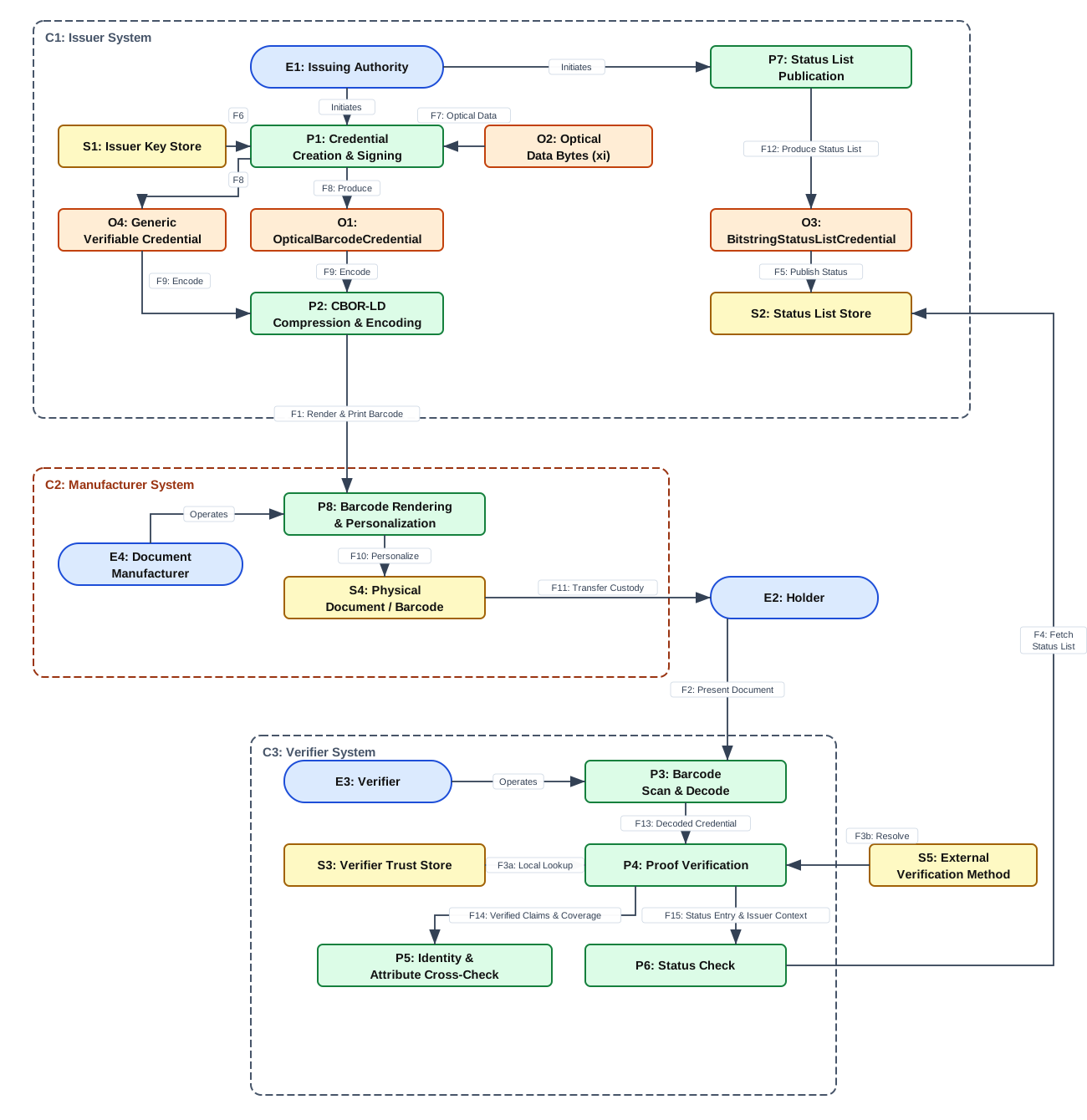
The following notation is used in the diagram description and dictionary. Every
element is labelled with a type letter and an index (for example, P4
or F3a), and every data flow carries an identifier so it can be
referenced from threats and responses.
- E - External Entity (human or legal person outside the system boundary), drawn as a rounded blue box.
- P - Process (running algorithm that transforms data), drawn as a green box.
- F - Data Flow (movement of data between elements), drawn as a labelled arrow. All data flows are drawn with solid lines; a flow that is not always performed (such as [=F4|F4=]) is noted as optional in its dictionary entry rather than by a distinct line style.
- S - Data Store (persistent or ephemeral storage), drawn as a yellow box.
- O - Data Object (self-contained, transferable artifact), drawn as an orange box.
- C - Contained System Boundary (collection of elements under a single controlling authority), drawn as a dashed rectangle enclosing its elements. A data flow that crosses a boundary line represents data, custody, or control passing between authorities. Elements drawn outside every boundary (such as the [=S5|external verification method=] store) are dependencies not controlled by any modelled party.
The diagram records the following assumptions, which constrain its scope and are called out here rather than left implicit:
- A1: Status services co-located with the issuer. The [=S2|status list store=] is drawn inside the [=C1|issuer system=]. In deployment, a status authority, hosting provider, or content distribution network may be operationally distinct from the credential issuer; placing [=S2|S2=] inside [=C1|C1=] is an intentional scope choice for this baseline model.
- A2: The holder and presenter of a credential are the same person. This holds for typical identity documents but not necessarily for generic verifiable credentials about goods, organizations, licenses, or certifications.
Dictionary
| E1 Issuing Authority |
An entity - such as a state motor vehicle agency, a passport authority, or
another document-issuing body - that creates and cryptographically signs
credentials for optical barcodes - both
[=O4|generic verifiable credentials=] and
OpticalBarcodeCredential resources - and operates the status
infrastructure for the documents it issues. The issuing authority controls
the signing keys and the verification method against which its credentials
are validated, and is the authority for any credential it issues.
|
| E2 Holder | The person who carries a physical document bearing a Verifiable Credential Barcode - for example the person named on a driver's license, employment authorization document, or travel document - and who presents that document to a verifier. The holder does not operate a system in this model; they carry the [=S4|physical document=]. |
| E3 Verifier |
An entity - such as a law enforcement officer, a border control or customs
agent, an age-verification clerk, or an automated inspection kiosk - that
scans the optical barcode, verifies the credential it carries - a
[=O4|generic verifiable credential=] or an
OpticalBarcodeCredential - cross-checks the signed data against
the visible document and the person when relevant, and optionally checks status
information. The verifier is configured to determine from each credential's type
and proof what its signature actually covers.
|
| E4 Document Manufacturer |
An organization or entity that renders an encoded credential —
a [=O4|generic verifiable credential=] or an
OpticalBarcodeCredential - into an optical barcode on a physical
card or document.
|
| P1 Credential Creation and Signing |
The process by which an issuing authority assembles and signs a credential for
an optical barcode. For a [=O4|generic verifiable credential=], the issuer
signs an ordinary Data Integrity proof over the claims the credential contains.
For an OpticalBarcodeCredential, the issuer computes the
[=O2|optical data bytes=] over the fields selected by the credential type's
component extraction rules (for example using protectedComponentIndex
against PDF417 key-value pairs) and signs with
the ecdsa-xi-2023 cryptosuite so the proof covers both the
credential and the optical data.
|
| P2 CBOR-LD Compression and Encoding |
The process by which a signed credential - a
[=O4|generic verifiable credential=] or an OpticalBarcodeCredential - is
compressed using CBOR-LD and then character-encoded so that it can be rendered into an
optical barcode.
|
| P3 Barcode Scan and Decode |
The process by which a verifier optically scans the barcode, reverses the
character encoding, and decompresses the CBOR-LD payload to recover the
credential and, when it is an OpticalBarcodeCredential, to
reconstruct the [=O2|optical data bytes=] from the document for verification.
|
| P4 Proof Verification |
The process by which a verifier checks the credential's proof. For a
[=O4|generic verifiable credential=], it verifies a standard Data Integrity
proof over the credential's claims. For an
OpticalBarcodeCredential, it additionally recomputes the hash of
the reconstructed [=O2|optical data bytes=] as required by
ecdsa-xi-2023. In both cases it resolves the issuer's
verificationMethod and confirms the signature is valid and that
the resolving issuer is trusted. The process produces an error if any check
fails.
|
| P5 Identity and Attribute Cross-Check | The process by which a verifier confirms that the signed data matches the data visible on the document, that the signed data matches the physical attributes of the person presenting it, and that the visible data matches that person. Only fields protected by the signature are relied upon for fraud detection — for a [=O4|generic verifiable credential=], that is solely the credential's own claims, since its signature covers no other data on the document. |
| P6 Status Check |
The process by which a verifier expands the
TerseBitstringStatusListEntry into a
BitstringStatusListEntry and checks the corresponding entry in the
issuer's status list to determine whether the document has been revoked or
suspended. This process is performed after proof verification succeeds.
|
| P7 Status List Publication |
The process by which an issuing authority creates and updates the
BitstringStatusListCredential that records the status of the documents
it has issued, and makes it available for retrieval.
|
| P8 Barcode Rendering and Personalization | The process, operated by the [=E4|document manufacturer=] within the [=C2|manufacturer system=], that receives the encoded credential via [=F1|Render and Print Barcode=], renders it as an optical barcode, and creates the [=S4|physical document=] that carries it. |
| F1 Render and Print Barcode | The data flow by which an encoded credential is delivered to the [=E4|document manufacturer=] and rendered as an optical barcode on a physical document. |
| F2 Present Document | The data flow by which a holder presents a physical document with an optical barcode to a verifier for scanning. This flow crosses the security boundary between the holder's possession and the [=C3|verifier's system=]. |
| F3 Resolve Verification Method |
The data flow by which a verifier obtains the issuer's public key material in
order to verify the credential. The model distinguishes two sub-flows:
F3a, a lookup in the verifier's [=S3|local trust store=] of
already-trusted key material and policy; and F3b, external
verification-method resolution, such as resolving a did:web
identifier from the [=S5|external verification method=] store. This threat model
treats threats in resolving an external verification method as largely out of scope,
as they are not specific to barcodes or other optical media in any way.
|
| F4 Fetch Status List |
The data flow by which a verifier retrieves, typically with a standard HTTP GET
request, the BitstringStatusListCredential Verifiable Credential
from the host identified by terseStatusListBaseUrl, receiving the
status list in response, in order to perform a status check. This flow is
optional: it occurs only when a verifier performs an online
[=P6|status check=], and is omitted when status is not checked or a cached
result is reused.
|
| F5 Publish Status | The data flow by which an issuing authority writes revocation and suspension updates into the status list store from which verifiers retrieve them. |
| S1 Issuer Key Store | The persistent storage within the [=C1|issuer system=] that holds the issuing authority's private signing keys. Compromise of this store undermines the authenticity guarantees of every credential signed with the affected key. |
| S2 Status List Store |
The persistent storage, typically a publicly retrievable web endpoint, where
the issuing authority publishes BitstringStatusListCredential
resources. Verifiers retrieve status lists from this store via
[=F4|Fetch Status List=].
|
| S3 Verifier Trust Store | The storage within the [=C3|verifier system=] that holds the set of issuing authorities and verification methods the verifier considers authoritative. It is consulted during [=P4|proof verification=] to decide whether a resolving issuer is trusted. |
| S4 Physical Document / Barcode | The physical document that carries the printed optical barcode. As a data store, it persistently holds one or more encoded Verifiable Credentials and is the medium presented by the holder and scanned by the verifier. It is outside any compute boundary and is readable by anything with optical access to it. This store moves from the custody of the [=E4|Document Manufacturer=], inside the [=C2|manufacturer system boundary=], to the custody of the [=E2|holder=]. |
| S5 External Verification Method | The external storage from which a verifier obtains issuer key material via [=F3|F3b=] when the verification method is not already present in the [=S3|verifier trust store=]. This document treats this store outside the existing boundaries for generality, although in many deployments this store will be controlled by a modelled entity such as the issuer. |
| O1 OpticalBarcodeCredential |
A compact, cryptographically-signed verifiable credential that secures the contents
of an optical barcode. It carries the issuer, a proof produced by the
ecdsa-xi-2023 cryptosuite, a credentialSubject whose
type is a subclass of the general MachineReadableInformation superclass
and optionally a TerseBitstringStatusListEntry. Each subclass defines the optical
data it secures, its component extraction rules, and its character encoding.
|
| O2 Optical Data Bytes (xi) |
The canonicalized "extra information" that is hashed
and bound into the ecdsa-xi-2023 signature. It extends the credential's
digital signature to cover other machine readable data on the document rather than
covering the credential alone.
|
| O3 BitstringStatusListCredential |
A verifiable credential, published by the issuing authority, that encodes status information
of a large set of Verifiable Credentials as a compressed
bitstring. Verifiers consult it during [=P6|status check=] after expanding the
credential's TerseBitstringStatusListEntry.
|
| O4 Generic Verifiable Credential Expressed as Barcode |
Generic verifiable credentials can be encoded into a barcode using this specification's
general encoding algorithms (CBOR-LD compressed, base45-multibase-encoded, prefixed with
VC1-). Here, the credential's Data Integrity proof covers only the claims
explicitly included in the credential itself and the digital signature covers no other
machine-readable data on the physical document.
|
| C1 Issuer System | The system boundary - typically the servers and key-management infrastructure operated by the issuing authority - that runs the [=P1|Credential Creation and Signing=], [=P2|CBOR-LD Compression and Encoding=] (in part), and [=P7|Status List Publication=] processes and maintains the [=S1|Issuer Key Store=] and [=S2|Status List Store=]. |
| C2 Manufacturer System |
The supply-chain system boundary controlled by the [=E4|document manufacturer=].
Its controlling authority is the manufacturer; its input is the encoded
credential delivered by [=F1|Render and Print Barcode=]; its process is
[=P8|Barcode Rendering and Personalization=]; and it holds the
[=S4|physical document=] while that document is in production, before custody
transfers to the [=E2|holder=]. The manufacturer is frequently a distinct
organization from the issuer, so the boundary between [=C1|C1=] and
C2 is a genuine supply-chain trust boundary.
|
| C3 Verifier System | The system boundary that runs the [=P3|Barcode Scan and Decode=], [=P4|Proof Verification=], [=P5|Identity and Attribute Cross-Check=], and [=P6|Status Check=] processes and holds the [=S3|Verifier Trust Store=]. |