Introduction
Threat modeling is a vital part of specification development. This document provides a threat model for the Data Integrity specification, which defines a mechanism for ensuring the authenticity and integrity of structured data documents. The mechanism uses cryptographic proofs that are created and verified through transformation, hashing, and proof serialization algorithms.
This threat model follows the methodology described in the W3C Threat Modeling Guide and classifies threats using the STRIDE taxonomy. Threats are grouped into five categories:
- Target Threats are threats the specification was designed to address.
- Implementation Threats are threats that implementers must handle; the specification leaves the choice of mitigation open.
- Deployment Threats are threats that arise from how systems are configured and operated.
- External Threats are real-world risks acknowledged as out of scope for this version of the specification.
- Dependency Threats are threats inherited from technologies the specification depends upon.
Description
The Data Integrity specification defines a mechanism for protecting the authenticity and integrity of documents through cryptographic proofs. A [=E1|signer=] takes an [=O1|input document=], [=P1|transforms=] it into a canonical form, [=P2|hashes=] the result, and [=P3|signs=] the hash using private key material held in a [=S1|security module=], producing a [=O2|signed document=] that carries one or more proofs. The [=O2|signed document=] is [=F1|transmitted to a holder=], who [=P4|stores=] it in [=S2|holder storage=] until it is needed and later [=F2|transmits it to a verifier=]. The [=E3|verifier=] runs the [=P5|verify=] process (re-transforming, re-hashing, and cryptographically checking each proof) to confirm that the document was created by the [=E1|signer=] and has not been modified since.
The core property the specification provides is that a [=E3|verifier=] receiving a [=O2|signed document=] can determine, in an automated and cryptographically verifiable way, whether the information in the document is authentic. This holds even when the document arrives long after it was created, over untrusted networks, and through intermediaries such as [=E2|holders=], and it requires no contact with the [=E1|signer=]. The concrete cryptographic mechanisms are supplied by cryptosuites, such as those defined in the ECDSA, EdDSA, and BBS cryptosuite specifications, which instantiate the transformation, hashing, proof serialization, and proof verification algorithms that this threat model examines.
For this threat model, we consider a minimal instantiation of a Data Integrity ecosystem consisting of three roles: the [=E1|Signer=] (E1) who creates [=O2|signed documents=], the [=E2|Holder=] (E2) who stores them and transmits them to other parties, and the [=E3|Verifier=] (E3) who checks their proofs and decides whether to accept them. In [=verifiable credential=] ecosystems, these roles correspond to the [=issuer=], holder, and verifier.
Note: We do NOT model potential attackers as first-class elements, as over-characterizing attackers can lead to analysis bias that is better avoided.
Data Flow Diagram for the Data Integrity Ecosystem
The data flow diagram below illustrates the key elements and data flows in a minimal Data Integrity ecosystem. The diagram shows how an input document (O1) is transformed, hashed, and signed within the signing system (C1) using key material held in the security module (S1), producing a signed document (O2) that is [=F1|transmitted to the holder=] (E2), [=P4|stored=] in holder storage (S2), and later [=F2|transmitted to a verifier=] (E3), whose [=P5|verify=] process confirms its authenticity.
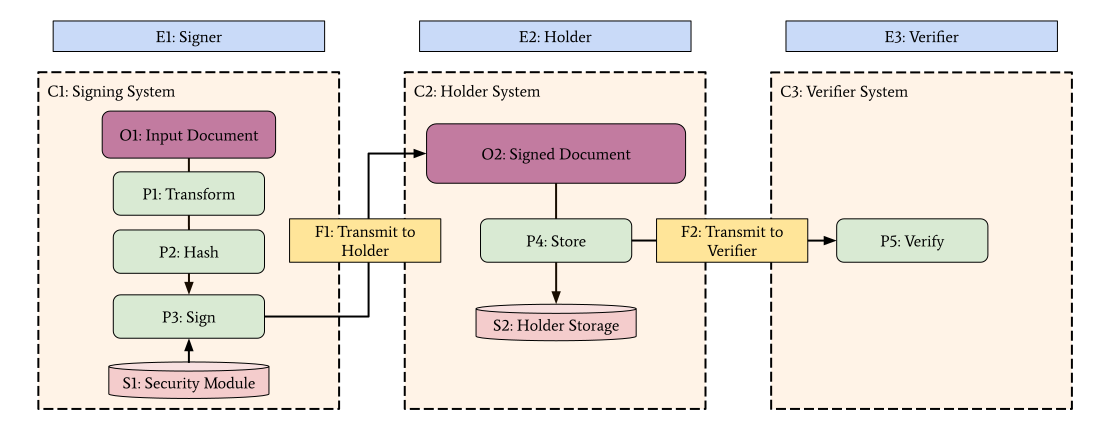
The following notation is used in the diagram description and dictionary:
- E denotes an External Entity (a human or legal person outside the system boundary)
- P denotes a Process (a running algorithm that transforms data)
- F denotes a Data Flow (movement of data between elements)
- S denotes a Data Store (persistent or ephemeral storage)
- O denotes a Data Object (a self-contained, transferable artifact)
- C denotes a Contained System Boundary (a collection of elements under a single authority)
Dictionary
| E1 Signer | An entity (such as a [=credential=] [=issuer=], a notary, a supply-chain participant, or an automated service) that makes cryptographically verifiable statements by creating [=Data Integrity proofs=] over input documents. The signer controls a [=controlled identifier document|controller document=], such as a CID or a [=DID document=], that expresses its verification methods, and controls the private key material corresponding to those [=verification methods=]. In [=verifiable credential=] ecosystems, this role is typically played by the [=issuer=]. |
| E2 Holder | A person or organization that receives signed documents from a signer, stores them, and transmits them to verifiers. The holder typically operates a software application, such as a digital wallet, and controls when, to whom, and (when a [=selective disclosure=] [=cryptosuite=] is used) how much of a signed document is disclosed. |
| E3 Verifier | An entity that receives a signed document and must determine whether the information it contains is authentic, meaning that it was created by the claimed signer and has not been modified since. The verifier runs the [=P5|Verify=] process and accepts or rejects the document based on the result and on its own policy, such as which [=cryptosuites=] and [=proof purposes=] it accepts. |
| P1 Transform | The process that converts an input document into the canonical form that is protected by a proof, using the transformation algorithm identified by the [=cryptosuite=], for example, RDF Dataset Canonicalization (RDFC-1.0) or the JSON Canonicalization Scheme (JCS). Transformation ensures that the proof protects the information expressed by the document rather than one particular byte serialization of it. This process runs during both proof creation and proof verification. |
| P2 Hash | The process that applies the cryptographic hash function identified by the [=cryptosuite=] to the transformed data, producing the compact value over which the proof is computed. This process runs during both proof creation and proof verification. |
| P3 Sign |
The process (called proof serialization by the specification) by which a
signer produces a proofValue over the hashed data using
private key material held in the [=S1|Security Module=], and assembles the
complete proof, including its type, cryptosuite,
verificationMethod, and proofPurpose properties
and optional properties such as created, expires,
domain, and challenge.
|
| P4 Store | The process by which a holder places a received signed document into [=S2|Holder Storage=] and retrieves it later for transmission to a verifier. |
| P5 Verify |
The process by which a verifier checks a received signed document. It
re-runs the [=cryptosuite|cryptosuite's=] transformation and hashing over the
document, cryptographically verifies the proofValue using the
[=verification method=] referenced by the proof, and confirms that the
[=verification method=] is bound to its [=controller=] and expressed under the
[=verification relationship=] matching the proof's
proofPurpose, that any expected domain and
challenge values match, and that the document's contexts
match known-good values.
|
| F1 Transmit to Holder | The data flow by which a signed document travels from the [=C1|signing system=] to the [=C2|holder system=]. This flow crosses the trust boundary between the signer's authority and the holder's authority. |
| F2 Transmit to Verifier | The data flow by which a holder delivers a signed document to the [=C3|verifier system=]. This flow crosses the trust boundary between the holder's authority and the verifier's authority, and is typically the first point at which the document is exposed to a party whose interests differ from the holder's. |
| S1 Security Module | The protected key store within the [=C1|signing system=] (such as a hardware security module, a trusted platform module, or an operating-system keystore) that holds the signer's private keys and performs signing operations without releasing private key material to application code. |
| S2 Holder Storage | The persistent storage within the [=C2|holder system=] where signed documents are kept, typically the storage of a digital wallet application. This storage is accessible only to the holder's software within the [=C2|holder system=] boundary. |
| O1 Input Document | A document, expressed in a syntax such as JSON or JSON-LD, that contains the information to be protected but does not yet carry a proof. It is the input to the proof-creation pipeline that runs within the [=C1|signing system=]. |
| O2 Signed Document | An input document combined with one or more [=Data Integrity proofs=]. A signed document can carry multiple proofs, either as a proof set (independent proofs over the same data, enabling cryptographic layering) or as a proof chain, where later proofs also protect earlier ones. It is self-contained: it can be transmitted and stored without losing its integrity protection. |
| C1 Signing System | The system boundary, typically a server or service operated by or for the signer, within which the [=P1|Transform=], [=P2|Hash=], and [=P3|Sign=] processes run and the [=S1|Security Module=] resides. Everything inside this boundary is under the signer's authority. |
| C2 Holder System | The system boundary, typically a mobile or desktop digital wallet application, within which the [=P4|Store=] process runs and [=S2|Holder Storage=] resides. Everything inside this boundary is under the holder's control. |
| C3 Verifier System | The system boundary, typically an automated verification service, within which the [=P5|Verify=] process runs. It is configured with the trust and policy decisions of the verifier, such as the [=cryptosuites=], [=proof purposes=], and document contexts it accepts. |