Introduction
Threat modeling is a vital part of specification development. This document provides a threat model for the Verifiable Credentials Data Model specification, which defines a data model for expressing cryptographically verifiable claims made by an [=issuer=] about one or more [=subjects=].
This threat model follows the methodology described in the W3C Threat Modeling Guide and classifies threats using the STRIDE taxonomy. Threats are grouped into five categories:
- Target Threats are threats the specification was designed to address.
- Implementation Threats are threats that implementers must handle; the specification leaves the choice of mitigation open.
- Deployment Threats are threats that arise from how systems are configured and operated.
- External Threats are real-world risks acknowledged as out of scope for this version of the specification.
- Dependency Threats are threats inherited from technologies the specification depends upon.
Each threat in this model is examined in isolation. However, good, scalable solutions always require balance, and almost any decision comes with trade offs. Readers are expected to take all relevant threats, advice, and mitigations into consideration to balance them appropriately to optimize for their solution's widest target audience.
Description
The Verifiable Credentials Data Model defines how an [=issuer=] makes cryptographically verifiable claims about one or more [=subjects=]. For this threat model, we consider a minimal instantiation of a verifiable credentials ecosystem consisting of three roles: the [=E1|Issuer=] (E1), who establishes confidence in a [=subject=] and issues a [=verifiable credential=]; the [=E2|Holder=] (E2), who stores [=verifiable credentials=] and generates [=verifiable presentations=] from them; and the [=E3|Verifier=] (E3), who receives a [=verifiable presentation=], verifies it, checks the status of any [=verifiable credentials=] it contains, and validates the result against its own policy.
The core property the specification provides is that a [=E3|verifier=] receiving a [=verifiable presentation=] can determine, in an automated and cryptographically verifiable way, whether the [=verifiable credentials=] it contains are authentic, unrevoked, and fit for the verifier's purpose. This holds even when a credential arrives long after it was issued, over untrusted networks, and through the [=holder=], and it requires no direct contact between the [=verifier=] and the [=issuer=] beyond retrieving public status information.
Note: We do NOT model potential attackers as first-class elements, as over-characterizing attackers can lead to analysis bias that is better avoided.
Data Flow Diagram for the Verifiable Credentials Ecosystem
The data flow diagram below illustrates the key elements and data flows in a minimal verifiable credentials ecosystem. It shows the [=E1|Issuer=] (E1) establishing confidence in the [=E2|Holder=] (E2) as a [=subject=] ([=F1|F1=]), assembling and issuing a [=verifiable credential=] that is delivered to the holder ([=F2|F2=]) and placed in [=S2|Holder Storage=] (S2). The holder later generates a [=verifiable presentation=] and exchanges it with the [=E3|Verifier=] (E3) ([=F3|F3=]), whose verification pipeline verifies the presentation, checks credential status against the issuer's [=S1|Status List Storage=] (S1) ([=F4|F4=]), and validates the result.
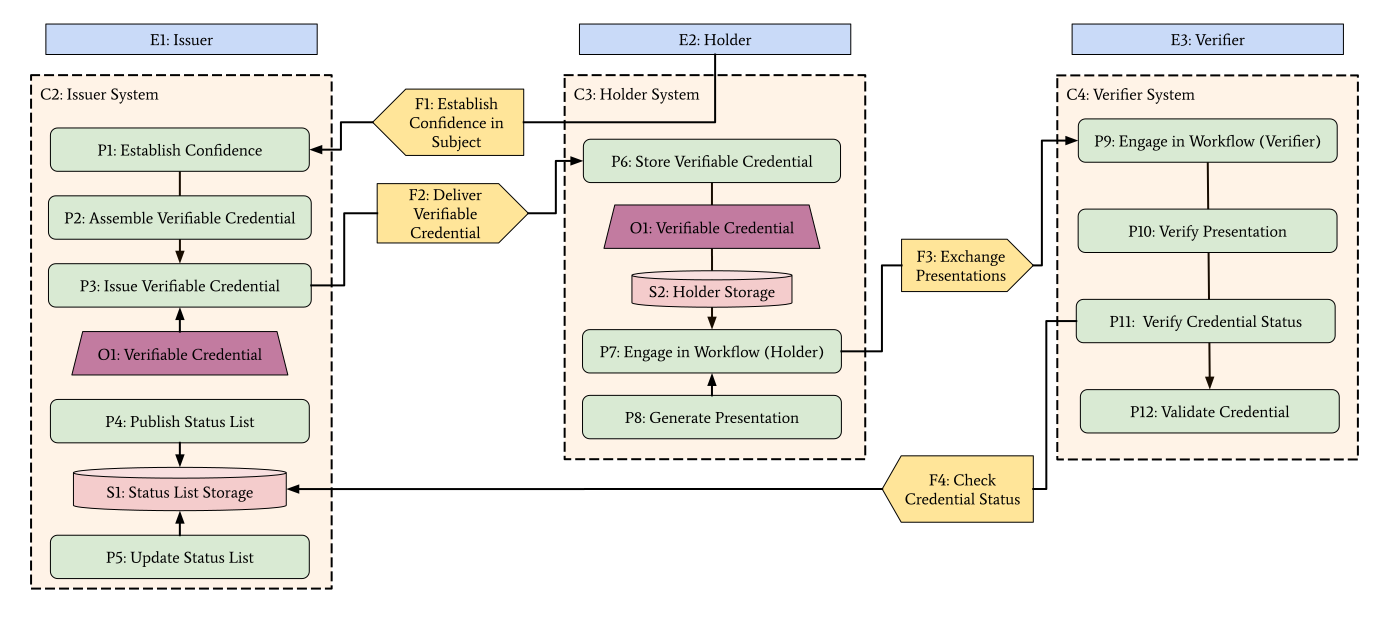
The following notation is used in the diagram description and dictionary:
- E denotes an External Entity (a human or legal person outside the system boundary)
- P denotes a Process (a running algorithm that transforms data)
- F denotes a Data Flow (movement of data between elements)
- S denotes a Data Store (persistent or ephemeral storage)
- O denotes a Data Object (a self-contained, transferable artifact)
- C denotes a Contained System Boundary (a collection of elements under a single authority)
Dictionary
The dictionary entries below are starting-point definitions to be reviewed and expanded. Each entry should describe the element in enough detail to support the threat analysis that references it.
| E1 Issuer | An entity that establishes confidence in a [=subject=], assembles a [=verifiable credential=] expressing claims about that subject, issues it, and publishes and maintains the status information used to determine whether the credential remains valid. |
| E2 Holder | A person or organization that receives [=verifiable credentials=], stores them, and generates [=verifiable presentations=] to share selected claims with [=verifiers=]. The holder is typically, though not always, the [=subject=] of the credentials it holds. |
| E3 Verifier | An entity that receives a [=verifiable presentation=] and must determine whether to rely on the [=verifiable credentials=] it contains, by verifying the presentation, checking credential status, and validating the result against its own policy. |
| P1 Establish Confidence | The process by which an issuer gains sufficient confidence in the identity or attributes of a [=subject=] before issuing a [=verifiable credential=]. |
| P2 Assemble Verifiable Credential | The process by which an issuer composes the claims, metadata, and status information of a [=verifiable credential=] prior to securing it. |
| P3 Issue Verifiable Credential | The process by which an issuer secures the assembled credential and delivers it to the holder. |
| P4 Publish Status List | The process by which an issuer publishes the status information used by verifiers to determine whether a credential has been revoked or suspended. |
| P5 Update Status List | The process by which an issuer updates the published status information, for example to revoke or suspend a previously issued credential. |
| P6 Store Verifiable Credential | The process by which a holder places a received [=verifiable credential=] into [=S2|Holder Storage=] and retrieves it later. |
| P7 Engage in Workflow (Holder) | The process by which a holder participates in an interaction workflow, including responding to requests and consenting to share credentials. |
| P8 Generate Presentation | The process by which a holder produces a [=verifiable presentation=] from one or more stored [=verifiable credentials=]. |
| P9 Engage in Workflow (Verifier) | The process by which a verifier participates in an interaction workflow, including requesting and receiving a [=verifiable presentation=]. |
| P10 Verify Presentation | The process by which a verifier cryptographically checks a received [=verifiable presentation=] and the [=verifiable credentials=] it contains. |
| P11 Verify Credential Status | The process by which a verifier checks the status of a [=verifiable credential=] against the issuer's published status information in [=S1|Status List Storage=]. |
| P12 Validate Credential(s) | The process by which a verifier evaluates the verified, unrevoked credential(s) against its own business policy to decide whether to accept them. |
| F1 Establish Confidence in Subject | The data flow by which the holder (as [=subject=]) provides the issuer with the information it needs to establish confidence prior to issuance. This flow crosses the trust boundary between the holder's authority and the issuer's authority. |
| F2 Deliver Verifiable Credential | The data flow by which a [=verifiable credential=] travels from the [=C1|issuer system=] to the [=C2|holder system=]. |
| F3 Exchange Presentation | The data flow by which a holder delivers a [=verifiable presentation=] to the [=C3|verifier system=]. This flow crosses the trust boundary between the holder's authority and the verifier's authority. |
| F4 Check Credential Status | The data flow by which the verifier retrieves published status information from the issuer's [=S1|Status List Storage=]. This flow crosses the trust boundary between the verifier's authority and the issuer's authority. |
| S1 Status List Storage | The storage within the [=C1|issuer system=] holding the published status information for issued credentials, retrievable by verifiers. |
| S2 Holder Storage | The persistent storage within the [=C2|holder system=] where [=verifiable credentials=] are kept, typically the storage of a digital wallet application. |
| C1 Issuer System | The system boundary, typically a server or service operated by or for the issuer, within which the issuer's processes run and [=S1|Status List Storage=] resides. |
| C2 Holder System | The system boundary, typically a mobile or desktop digital wallet application, within which the holder's processes run and [=S2|Holder Storage=] resides. |
| C3 Verifier System | The system boundary, typically an automated verification service, within which the verifier's processes run and its trust and policy decisions are configured. |