[[JSON-LD11]] is a JSON-based format to serialize Linked Data [[LINKED-DATA]]. In recent years, [[YAML]] has emerged as a more concise format to represent information that had previously been serialized as [[JSON]], including API specifications, data schemas, and Linked Data.

This document defines YAML-LD as a set of conventions on top of YAML which specify how to serialize Linked Data as YAML based on JSON-LD syntax, semantics, and APIs.

Since YAML is more expressive than JSON, both in the available data types and in the document structure (see [[RFC9512]]), this document identifies constraints on YAML such that any YAML-LD document can be represented in JSON-LD.

This specification was initially developed by the JSON-LD Community Group.

Introduction

YAML-LD applies JSON-LD's data model and processing model to YAML so that Linked Data can be written in a YAML syntax while remaining representable as JSON-LD.

It is intended for documents that are read and written by humans and by software agents, including those based on Large Language Models.

An introductory YAML-LD example is presented below.


How to read this document

To understand the basics of this specification, one must be familiar with the following:

This document is intended primarily for two main audiences, as described below.

Terminology

This document uses the following terms as defined in external specifications and defines terms specific to JSON-LD.

A YAML-LD stream is a YAML stream of YAML-LD documents. On disk or on the wire, YAML-LD is always exchanged as a YAML-LD stream (one stream per file or HTTP body), containing one or more YAML-LD documents.

A YAML-LD document is any YAML document from which a conversion to [[JSON]] produces a valid JSON-LD document which can be interpreted as [[LINKED-DATA]].

The term media type is imported from [[RFC6838]].

The term JSON is imported from [[JSON]].

The term JSON document represents a serialization of a resource conforming to the [[JSON]] grammar.

The terms JSON-LD document, and value object are imported from [[JSON-LD11]].

The terms internal representation, and documentLoader are imported from [[JSON-LD11-API]].

The terms array, boolean, map, map entry, null, and string are imported from [[INFRA]].

The term number is imported from [[ECMASCRIPT]].

The terms YAML, YAML representation graph, YAML stream, YAML directive, TAG directive, YAML document, YAML sequence (either block sequence or flow sequence), YAML mapping (either block mapping or flow mapping), node, scalar, node anchor, node tags, and alias node, are imported from [[YAML]].

The term content negotiation is imported from [[RFC9110]].

The terms RDF literal, language-tagged string, datatype IRI, and language tag are imported from [[RDF11-CONCEPTS]].

The terms fragment and fragment identifier in this document are to be interpreted as in [[URI]].

The term Linked Data is imported from [[LINKED-DATA]].

Namespace Prefixes

This specification makes use of the following namespace prefixes:

Prefix IRI
ex https://example.org/
i18n https://www.w3.org/ns/i18n#
rdf http://www.w3.org/1999/02/22-rdf-syntax-ns#
rdfs http://www.w3.org/2000/01/rdf-schema#
xsd http://www.w3.org/2001/XMLSchema#
schema https://schema.org/
prov http://www.w3.org/ns/prov#
See YAML-LD version of this table at namespace-prefixes.yamlld .

These are used within this document as part of a compact IRI as a shorthand for the resulting IRI, such as schema:url used to represent https://schema.org/url.

A YAML-LD document complies with the YAML-LD Basic profile of this specification if it follows the normative statements from this specification and can be transformed into a [[JSON-LD11]] representation, then back to a conforming YAML-LD document, without loss of semantic information.

For convenience, normative statements for documents are often phrased as statements on the properties of the document.

Base Specification Versions

YAML-LD supports [[[JSON-LD11]]] [[JSON-LD11]] and later.

YAML-LD is based on [[[YAML]]] [[YAML]]. YAML-LD processors MUST use a YAML 1.2 (or later, backward-compatible) implementation; see for the interoperability concerns that arise with YAML 1.1. Implementers MAY specify the YAML version in a given document by using the `%YAML` directive.

Test Suites

To be conformant, an implementation MUST satisfy all test cases from the following test suites:

...disregarding the test cases where:

Since YAML is a superset of JSON, testing a YAML-LD implementation against test cases from JSON-LD test suites should be trivial.

Basic Concepts

JSON vs YAML comparison

[[YAML]] is a superset of [[JSON]], i.e., every valid JSON document is also a valid YAML document. YAML also offers a number of extra features, chief among which is improved human readability due to the minimized punctuation requirements.

YAML is more flexible than JSON, as illustrated by the comparison table below.

Features [[JSON]] [[YAML]] YAML-LD
Allowed encodings
UTF-8
UTF-16
UTF-32
Native data types
{} object
[] array
string
number
integer
floating point
bool
null
Features
Delimited strings, arrays, objects
Punctuation-free strings, arrays, objects
Custom types ✅ via tags Core Schema only
Documents per file 1 ⩾ 1 via YAML stream ⩾ 1 (depending on extractAllScripts flag, see Stream Processing)
Comments Treated as Whitespace
Anchors & aliases Anchor names do not bear semantic information
Cycles ❌ Not permitted
Mapping key types string Any type representable in YAML, from strings to mappings string
See YAML-LD version of this table at json-vs-yaml.yamlld .

[[?eriksson-hallberg]] showed that, although YAML can be larger than equivalent JSON for some deeply nested documents, for many flatter documents it is smaller than pretty-printed JSON while remaining human-readable. That combination can reduce the amount of text that large language models and other software agents must process, without requiring a separate minified encoding.

Goal of this specification

The goal of this specification is to allow a JSON-LD document to be processed and serialized into YAML, and then back into JSON-LD, without losing any semantic information.

This is always possible because

JSON-LD serialization of Example 1:


Core Requirements

[[[YAML]]] describes YAML processing in a number of steps, reproduced in . This processing transforms a stream of characters in the YAML syntax (on the right) to and from a so-called "native data structure" (on the left). In JSON-LD, that data structure is the JSON-LD [=internal representation=].
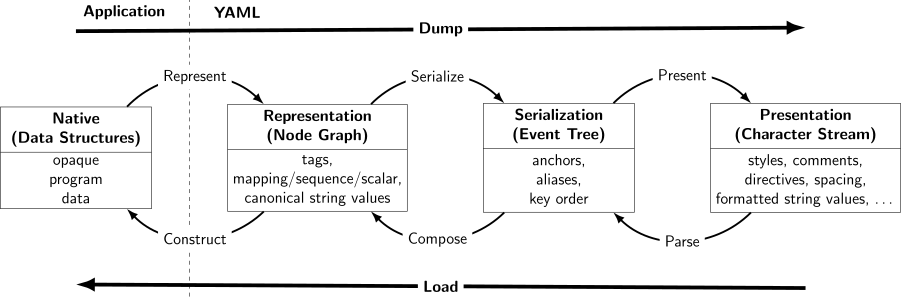
YAML Processing Overview
YAML processing overview, from [[YAML]]

This section describes the requirements imposed by YAML-LD on the YAML processing steps, in the load direction (right to left in ). Dump proceeds in the opposite direction, producing a conforming YAML-LD stream from a JSON-compatible [=internal representation=].

Presentation

Presentation is the YAML character stream in .

Encoding

JSON text exchanged between systems that are not part of a closed ecosystem MUST be encoded using UTF-8.

A YAML-LD stream MUST be encoded in UTF-8; otherwise, an invalid-encoding error MUST be detected, and processing aborted.

Comments

Comments are a presentation detail and must not have any effect on the serialization tree or representation graph.

Comments in YAML-LD streams are treated as white space.

See YAML and JSON interoperability considerations for more details.

Streams

YAML allows several serialization trees to be contained in the same YAML presentation stream, as a series of documents separated by markers.

A YAML-LD stream MAY contain more than one YAML-LD document, as shown below.


For interoperability considerations on YAML streams, see the relevant section in YAML Media Type.

Serialization

Serialization is the ordered tree produced by Parse (and consumed by Present) in .

Anchors and Aliases

Anchor names are a serialization detail and are discarded once composing is completed.

In this specification, anchor means YAML's node anchor mechanism (with alias nodes, using & and * in the serialization) to reuse the same logical node by reference in the serialized graph. It is not related to HTML hyperlinks or URL fragment identifiers. See [[YAML]] §6.9.2 Node Anchors.

Consequently, anchor names MUST NOT be used to convey relevant information, MAY be altered when processing the document, and MAY be dropped during YAML-LD processing.

Anchors are particularly useful within a @context block. When several terms share the same term definition — for example, all IRI-valued properties — the shared definition can be anchored once and aliased for each term, avoiding repetition. The following example anchors the IRI coercion definition as &iri and reuses it for three properties:


Once all anchors and aliases have been resolved, the equivalent JSON-LD is:


Representation

Representation is the YAML representation graph produced by Compose in .

A YAML-LD document MAY contain anchored nodes and alias nodes in its serialization, but its representation graph MUST NOT contain cycles; otherwise, a loading-document-failed error MUST be detected, and processing aborted.

When composing the representation graph, each alias node MUST resolve to the node identified by its target anchor. When constructing the JSON-LD [=internal representation=], each reference to that node MUST be treated as a copy of the node.

Scalar Value Types

When composing a complete representation graph, YAML-LD uses the YAML Core Schema for scalar type resolution. Float values that cannot be represented in [[JSON]] — specifically infinity (.inf, -.inf, +.inf) and not-a-number (.nan) — MUST cause a loading-document-failed error to be raised when constructing the JSON-LD [=internal representation=].

The YAML Core Schema does not define a timestamp type; scalars such as 2018-04-01 resolve to plain strings. However, many YAML libraries implement YAML 1.1 timestamp resolution by default and will silently convert such scalars to native date or datetime objects. YAML-LD processors MUST NOT perform such conversion and MUST treat these values as strings.

YAML-LD does not assign additional JSON-LD meaning to node tags beyond the scalar type resolution defined by the YAML Core Schema.

Native Data Structure

The native data structure produced by Construct in is the JSON-LD [=internal representation=].

Stream Processing

[[JSON-LD11-API]] defines the `extractAllScripts` flag, which allows to parse multiple `<script>` tags with JSON-LD content in an HTML document.

A conformant YAML-LD implementation MUST apply this flag when constructing the JSON-LD [=internal representation=] from a YAML-LD stream.

  • If the flag is `true`, the internal representation MUST be an array containing the constructed value of each document in the stream, even if the stream contains only one document.
  • If the flag is `false`, only the first document in the stream MUST be constructed.

Mapping Key Types

An object structure is represented as a pair of curly brackets surrounding zero or more name/value pairs (or members). A name is a string.

Consequently, all mapping keys in YAML-LD MUST be strings. Otherwise, a `mapping-key-error` error is raised.

JSON literals

The @json keyword from JSON-LD 1.1 defines a JSON literal as a value object with @type @json and @value containing JSON data. A processor treats such a value as a JSON literal, rather than interpreting it further as JSON-LD. Consider the following example.


Consider the expanded form.


Although the keyword is named @json, it does not require the value of @value to be written using JSON syntax in YAML-LD. As this example shows, the metadata value object is preserved during expansion in its JSON-LD form, — as this keyword mandates.

When it is converted to RDF, the JSON literal's lexical form is JSON text reconstructed from the internal representation.

YamlLdErrorCode

The YamlLdErrorCode represents the collection of valid YAML-LD error codes, which extends the {{JsonLdErrorCode}} definitions.

enum YamlLdErrorCode {
  "invalid-encoding",
  "mapping-key-error",
  "profile-error"
};
    
invalid-encoding
The character encoding of an input is invalid.
mapping-key-error
A YAML mapping key was found that was not a string.
profile-error
The parsed YAML document contains features incompatible with the specified profile.

Security Considerations

See Security considerations in JSON-LD 1.1 and +yaml structured syntax suffix.

Privacy Considerations

See Privacy considerations in JSON-LD 1.1.

Interoperability Considerations

For general interoperability considerations on the serialization of JSON documents in [[YAML]], see YAML and the Interoperability considerations of the +yaml structured syntax suffix.

The considerations and analysis provided here, including interoperability and security considerations, are based on the YAML 1.2.2 specification.

Many popular YAML libraries default to YAML 1.1 parsing. YAML 1.1 implementations cause interoperability issues; in particular, the so-called "Norway problem" arises because YAML 1.1 treats no, No, NO, yes, on, off, and similar values as booleans, whereas YAML 1.2 Core Schema treats them as plain strings. YAML-LD processors that use a YAML 1.1 library will fail the conformance tests and are not compliant.

Embedding YAML-LD in HTML Documents

YAML-LD content can be easily embedded in HTML [[HTML]] by placing it in a <script> element with the `type` attribute set to `application/ld+yaml`, as illustrated in an example below.


YAML syntax is indentation based. Therefore, when processing each `<script>` block with YAML-LD content, YAML-LD processor MUST preserve the content of the block for YAML parsing as-is, including whitespace characters.

If the YAML-LD <script> tag contains a YAML Stream with multiple YAML documents, each of these documents MUST be treated as if it was included in a separate <script> tag. See Stream Processing for details.

IANA Considerations

This section has been submitted to the Internet Engineering Steering Group (IESG) for review, approval, and registration with IANA.

This section describes the information required to register the above media type according to [[RFC6838]]

application/ld+yaml

Type name:
application
Subtype name:
ld+yaml
Required parameters:
N/A
Optional parameters:
profile

A non-empty list of space-separated URIs identifying specific constraints or conventions that apply to a YAML-LD stream according to [[RFC6906]]. A profile does not change the semantics of the resource representation when processed without profile knowledge, so that clients both with and without knowledge of a profiled resource can safely use the same representation. The profile parameter MAY be used by clients to express their preferences in the content negotiation process. If the profile parameter is given, a server SHOULD return a document that honors the profiles in the list which it recognizes, and MUST ignore the profiles in the list which it does not recognize. It is RECOMMENDED that profile URIs are dereferenceable and provide useful documentation at that URI. For more information and background please refer to [[RFC6906]].

This specification allows the use of the `profile` parameters listed in and additionally defines the following:

http://www.w3.org/ns/json-ld#extended
To request or specify the YAML-LD Extended Profile.
This is a placeholder for specifying something like the YAML-LD Extended Profile making use of YAML-specific features.

When used as a media type parameter [[RFC4288]] in an HTTP Accept header field [[RFC9110]], the value of the profile parameter MUST be enclosed in quotes (") if it contains special characters such as whitespace, which is required when multiple profile URIs are combined.

When processing the "profile" media type parameter, it is important to note that its value contains one or more URIs and not IRIs. In some cases it might therefore be necessary to convert between IRIs and URIs as specified in section 3 Relationship between IRIs and URIs of [[RFC3987]].

Encoding considerations:
Same as +yaml.
Security considerations:
See .
Interoperability considerations:
See .
Published specification:
http://www.w3.org/TR/yaml-ld
Applications that use this media type:
Any programming environment that requires the exchange of directed graphs.
Additional information:
Deprecated alias names for this type:
N/A
Magic number(s):
Same as application/yaml
File extension(s):
  • .yaml
  • .yamlld
Macintosh file type code(s):
Same as application/yaml
Windows Clipboard Name:
Same as application/yaml
Person & email address to contact for further information:
W3C JSON-LD Working Group <public-json-ld-wg@w3.org>
Intended usage:
Common
Restrictions on usage:
N/A
Author(s):
Roberto Polli, Gregg Kellogg
Change controller:
W3C

Why are comments treated as whitespace?

Consistency

[[?TURTLE]] and other Linked Data serializations which support comments
do not provide a means to preserve them when processing and serializing the document in other formats
YAML
requires that parts of the document not reflected by representation graph, such as
  • comments
  • directives
  • mapping key order
  • anchor names
must not be used to convey application level information.

Predictability

Theoretically, we could try harvesting YAML comments into JSON-LD documents. We would define a specific predicate, like https://json-ld.org/yaml-ld/comment, and convert every # My comment fragment into a {"yaml-ld:comment": "My comment"} piece of the JSON-LD document.

This would, however, have the following impacts on implementations:

Acknowledgements

In Memoriam

Gregg Kellogg was a central figure in the story of JSON-LD and YAML-LD. He worked tirelessly on JSON-LD and many other specifications for more than a decade, right up until his death on September 6th, 2025. Gregg's passion for solving hard problems with finesse was only exceeded by his willingness to collaborate with and encourage others in reaching that destination. The JSON-LD and broader Linked Data communities will be forever grateful for Gregg's consistent, careful, and kindly delivered contributions during their most formative years.

Contributions

The editors would especially like to thank the following individuals for making significant contributions to the authoring and editing of this specification: